If you're shopping lift kits and truck accessories in Reading, start by deciding whether you need a leveling upgrade or a full suspension lift. A leveling upgrade corrects factory rake and keeps daily manners intact, while a suspension lift kit adds clearance, wheel travel, and larger tire fitment. You'll want exact year, trim, drivetrain, and suspension details to verify Rough Country fitment. Budget for tires, alignment, and accessories like steps, lights, or liners—you'll see how the right setup comes together.
Main Points
- Choose a leveling option to remove factory rake while keeping near-stock handling and fitting bigger tires for daily driving.
- Choose a suspension lift for increased clearance, wheel travel, and off-road performance, understanding that steering response may differ.
- Validate proper fitment using your truck's year, model, make, drivetrain, trim, cab, bed, and suspension type before ordering your Rough Country components.
- Select lift height and shocks based on your application, such as commuting, mixed trail use, towing, or serious off-road travel.
- Budget for more than the kit price, including alignment, labor, wheels, tires, shocks, and add-on accessories like steps, lights, and liners.
Comparing Suspension Lift Kits and Leveling Kits
Even though both upgrades change your truck's stance, suspension lift kits and leveling kits solve different problems and deliver different outcomes. A leveling kit usually raise the front to meet the rear, correcting factory rake with minimal change to geometry, ride height, and daily drivability. You select one when you seek a cleaner look and capacity for slightly larger tires.
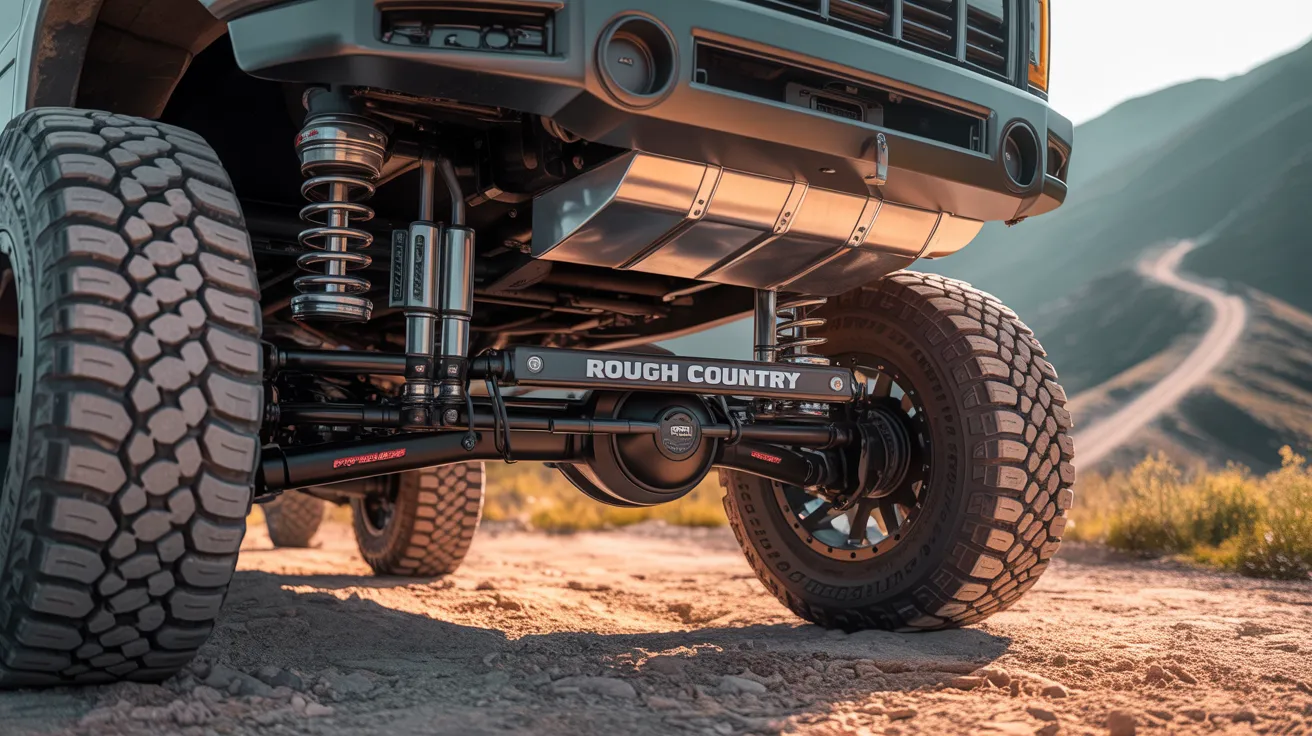
A suspension lift raises the whole truck and adjusts critical parts to provide more ground clearance and wheel travel. You'll see larger advantages in ride height, off-road capability, and tire options, but you should expect handling tradeoffs, steering changes, and a higher center of gravity. When you prefer subtle visual enhancement, level it. When you require real clearance and articulation, apply a suspension lift and plan the supporting mods tailored to your application.
Determine which Rough Country lift kit is right your truck.
Begin by identifying your truck's year, manufacturer, and model, transmission type, and planned purpose, because Rough Country engineers lift kits for exact platform geometry and capability objectives. That baseline determines which structural components and hardware will attach properly without clearance or geometric concerns.
Subsequently, check factory ride height, cab layout and bed configuration, axle configuration, and if your truck runs 2WD, 4WD, or adaptive suspension. Rough Country compatibility guides streamline this process, yet you have to check trim compatibility against trim-level hardware and OEM package variations. A kit made for a Silverado 1500 may not fit a Trail Boss, and a Ram running air-based suspension requires different provisions than a truck with coil springs. When you verify fitment upfront, you sidestep fitment surprises, component conflicts, and returns.
What Rough Country lift kit is right your driving habits?
Select the kit to the way you drive, and you'll receive enhanced ride quality, reliability, and additional tire clearance without paying for unused capability. If you primarily commute in your truck, pick a basic Rough Country leveling kit or a 2 to 3.5 inch suspension setup tuned for daily comfort and predictable steering behavior.
If you divide time between road and off-road use, step up to a suspension lift featuring upgraded shocks and adjusted control arm geometry. You'll achieve better trail handling, improved articulation, and room for larger tires without overloading OEM components. For heavier trail use, prioritize lifted shock struts, N3 and Vertex dampers, and setups that keep driveline angles correct under compression. The right Rough Country package must match load, speed, terrain, and how firm a ride you can accept.
Best Rough Country Truck Accessories
Finish your lift setup by adding Rough Country aftermarket items that solve the genuine problems you'll see once you lift it and add bigger tires. Start with new running boards or rock guards, that restore vehicle access and offer undercarriage protection when your truck sits higher and wider.
Next, prioritize
What's the Right Budget for Your Build?
After selecting the suspension lift and supporting accessories, set aside a budget above the base price. You'll need funding for shock units, wheels, tires, alignment, labor, and any drivetrain or steering corrections your vehicle type demands. Brand reputation counts; quality kits usually offer tighter tolerances, smoother rides, and easier installations.
In terms of practical budget estimates, assume entry-level spacer or leveling systems to start lower, while full access this information suspension systems with control arms, tuned dampers, and larger tires surge upward. Installation complexity, service fees, and recalibration work can add substantially. You should also price supplementary upgrades including gear changes, brake systems, and recovery equipment if trail use is planned. If cash flow matters, weigh financing options cautiously and stress reliability over flashy add-ons.
Popular Questions About Lifts
How Do Lift Kits Influence Warranty Coverage?
Yes, suspension kits can affect your factory warranty coverage, but they won't automatically cancel it. You face warranty implications should the manufacturer demonstrates the lift modification brought about or was part of a defect. Engine, steering, suspension, and drivetrain problems frequently create dealer conflicts. You need to preserve installation records, use quality components, and maintain service schedules. That helps you refute denied claims and safeguard warranty where the modification isn't responsible.
Does Going Bigger Require Gear Changes?
Yes—when you jump several tire sizes, you'll often require gearing changes. Consider moving from 31s to 35s, for example—your vehicle may feel underpowered, hunt for gears, plus create drivetrain pressure under strain. Re-gearing restores effective gear ratios, helping you get back acceleration, towing efficiency, and transmission operation. You may not require regearing for small tire upgrades, but if power, fuel economy, or shift quality drop, it's typically the right decision.
How Frequently Should You Inspect Lift Parts?
You must examine lift kit components after the first 500 miles, subsequently at every oil change or 3,000 to 5,000 miles, depending on your driving habits. Periodic inspections assist you in notice bushing wear, shock leaks, bracket damage, and alignment issues early. Test bolt tension post-rough terrain, towing situations, or impact events. If you drive in mud, salt, or rough terrain often, shorten intervals and inspect steering and suspension parts more frequently.
Does a lift kit impact towing or payload capacity?
Yes, a suspension lift can modify your towing and payload capacity. When you raise ride height for additional dirt clearance, you change suspension alignment, weight balance, and force distribution on parts. That can compromise stability under load and add drivetrain strain, most notably with bigger tires. You should stick with your manufacturer's ratings unless an engineered kit explicitly states revised capacities. Correct alignment, gearing, and brake performance count as well.
Are wheel alignment Required Once You Install vehicle modifications?
Yes—if accessories shift suspension height, suspension angles, steering angles, or tire size, you require an alignment service. You'll feel the theory instantly: slight changes can steer your truck off-center, reduce tread life, and compromise handling. A proper wheel alignment realigns camber, caster measurement, and toe measurement to standard specs. After specific add-ons, you should also consider brake adjustment for driver-assist accuracy. You maintain tire life, steering precision, and practical safety by getting alignment checked immediately.
Final Thoughts
Choosing the proper suspension setup and accessories comes down to how you use your truck, your preferred stance, and what your budget can handle. When you tune a Rough Country lift kit within your driving approach, you'll experience durability, space, and aesthetics that work together like a well-tuned drivetrain. Integrate wise upgrades, plan your spend carefully, and you'll build a truck remaining practical on the road, capable off it, and equipped for anything next.